Reading Time: 12 minutes
Open any first-draft essay, literature review, or discussion chapter and you will usually find the same problem in the first five paragraphs: “however” doing all the work. It opens sentences, it closes arguments, it sits in the middle of clauses it has no business being in, and by page three it has become the only word in the writer’s vocabulary for signalling contrast. Markers notice. Style guides warn against it. And searching for a synonym at 11pm rarely produces anything more useful than a thesaurus dump with no explanation of which word actually fits an academic sentence. This guide fixes that. Below you will find the strongest formal alternatives to “however,” the exact punctuation each one requires, real academic-style example sentences, and a clear framework for choosing the right word for a literature review, a discussion section, or a thesis introduction — not just a list.
Why “However” Isn’t Always the Right Choice
“However” is not wrong. It is simply overused, and overuse creates two real problems in academic writing. First, repetition flattens your prose and signals to a marker or reviewer that your vocabulary range is limited — a factor explicitly assessed in most UK university marking rubrics under “range and control of academic language.” Second, “however” is tonally neutral. It tells the reader that a contrast is coming but says nothing about the strength of that contrast. Academic writing frequently needs more precision than that: is this a mild qualification, a direct contradiction, or a full concession before a counter-argument? English has words for all three registers. Choosing the right one is a mark of writing maturity, not decoration.
This matters most in three places: literature reviews (where you are constantly weighing contradictory studies against each other), discussion sections (where you compare your findings to existing research), and thesis or dissertation chapters, where transitional precision is read as evidence of analytical control. If you’d rather not comb through your own draft manually, Small Study Tools has a free Transition Words Checker that scans your text and flags exactly how often you’ve leaned on “however” and similar connectors, so you can see the repetition before a marker does.
What Is a Conjunctive Adverb? (And Why It Governs Every Rule Below)
“However,” “nevertheless,” “nonetheless,” “moreover,” and “therefore” all belong to the same grammatical category: conjunctive adverbs (also called transitional adverbs). Unlike coordinating conjunctions such as “but” or “and,” a conjunctive adverb cannot join two independent clauses on its own with just a comma — doing so creates a comma splice, one of the most common punctuation errors in academic drafts. This single grammatical fact is the reason almost every punctuation rule in this article exists, so it’s worth understanding before you look at the tables below. Purdue OWL’s guide to conjunctive adverbs and the Chicago Manual of Style both treat this distinction as fundamental to formal English punctuation.

The Strongest Formal Synonyms for However
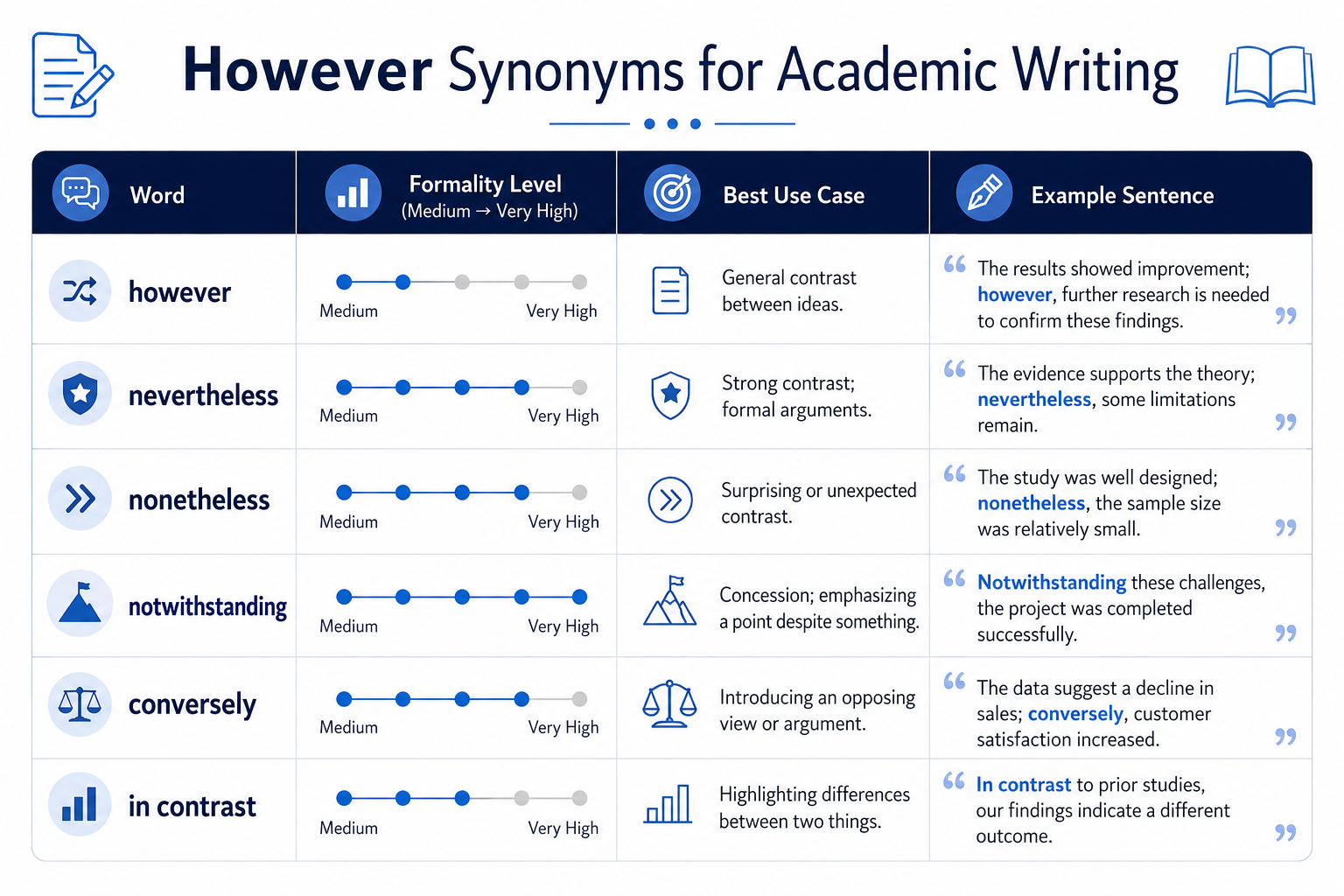
These are the highest-register alternatives — appropriate for a thesis, journal article, or formal report. Use the table to match tone precisely rather than picking at random.
| Synonym | Core Meaning | Formality Level | Best Academic Context | Punctuation Pattern |
|---|---|---|---|---|
| Nevertheless | Despite what was just stated | Very high | Discussion sections, concessions before a counter-claim | Semicolon + comma (mid-sentence) or comma (sentence-initial) |
| Nonetheless | In spite of that fact | Very high | Thesis conclusions, formal argumentation | Semicolon + comma or sentence-initial comma |
| Notwithstanding | Despite; in spite of | Very high, slightly archaic | Legal, policy, and historical writing | Often used prepositionally (no adverbial comma needed) or sentence-initial comma |
| Conversely | From the opposite viewpoint | High | Comparing two data sets or opposing theories | Semicolon + comma or sentence-initial comma |
| In contrast | Showing a clear point of difference | High | Comparing findings across studies | Sentence-initial comma; semicolon if joining clauses |
| By contrast | Highlighting a direct opposite | High | Literature review comparisons | Sentence-initial comma |
Example sentences:
-
- The 2019 cohort study reported a significant reduction in symptoms; nevertheless, the sample size limits the generalisability of these findings.
- Smith (2021) argues that centralisation improves efficiency. Conversely, Patel (2022) finds that decentralised structures outperform centralised ones in volatile markets.
- The policy achieved its stated employment targets; it did not, notwithstanding this success, address the underlying wage stagnation identified in earlier reports.
Moderate Alternatives for Everyday Academic Contrast
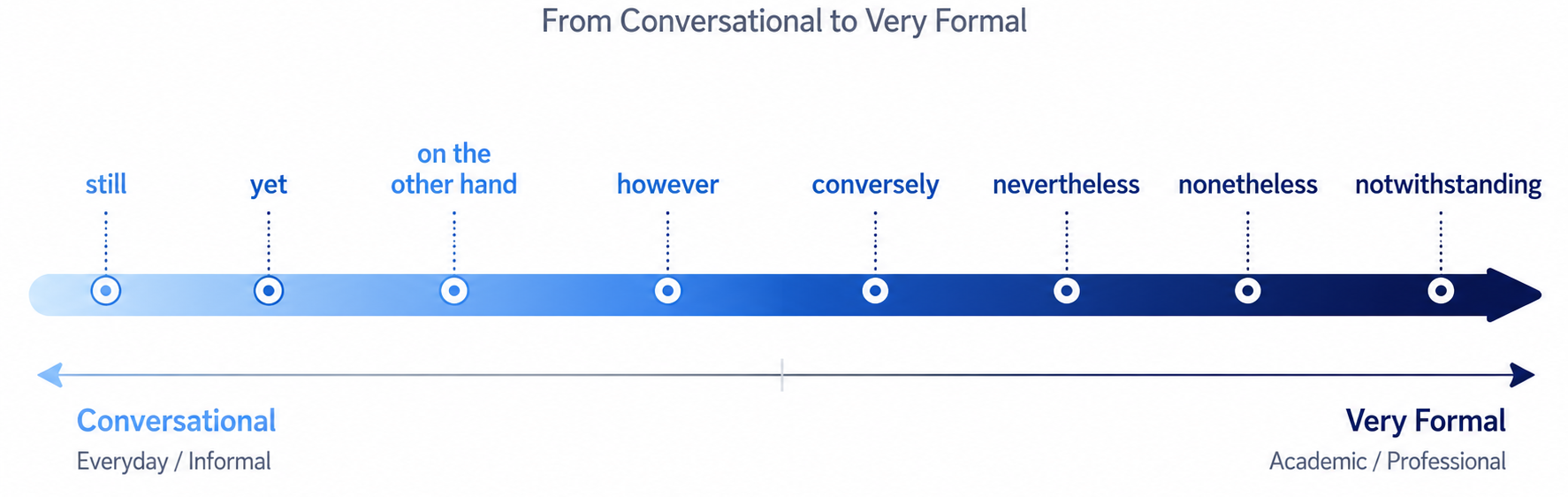
Not every contrast needs the weight of “nevertheless.” These alternatives are slightly more conversational but still fully acceptable in undergraduate and postgraduate academic writing, particularly in the body paragraphs of essays and reports.
| Synonym | Meaning | Formality Level | Best Use | Punctuation Pattern |
|---|---|---|---|---|
| On the other hand | Presenting an alternative view | Medium | Balancing two arguments in an essay | Sentence-initial comma |
| That said | Acknowledging a point before qualifying it | Medium | Softening a critique of a source | Sentence-initial comma |
| Even so | Despite the preceding point | Medium | Short qualifying statements | Sentence-initial comma |
| Still | Contrast with mild concession | Medium-low | Informal academic blogs, reflective writing | Sentence-initial comma; use sparingly in formal essays |
| Yet | Direct but understated contrast | Medium | Short, punchy contrast within a paragraph | Can function as coordinating conjunction (comma before) or sentence-initial adverb |
Concessive Phrases: When You Need to Concede Before You Contrast
A genuinely underused category. Concessive phrases don’t just signal contrast — they explicitly acknowledge the validity of the preceding point before pivoting. This is exactly the move most discussion sections and critical literature reviews need but rarely use correctly.
| Phrase | Function | Grammatical Type | Example Use |
|---|---|---|---|
| Although / Even though | Introduces a subordinate concessive clause | Subordinating conjunction | Although the sample was small, the effect size was substantial. |
| Despite / In spite of | Introduces a concessive noun phrase | Preposition | Despite methodological limitations, the results align with prior research. |
| While | Concessive contrast within one sentence | Subordinating conjunction | While quantitative data supports this trend, qualitative interviews suggest otherwise. |
| Granted | Explicit concession before rebuttal | Sentence adverb | Granted, the response rate was low; the findings still merit further investigation. |
| Admittedly | Signals a weakness before qualifying it | Sentence adverb | Admittedly, the model does not account for seasonal variation. |
❤️Need Affordable Assignment or Dissertation Support?
WhatsApp our writer NOW
(Click on the number to jump to the WhatsApp Message Section.): +44 7876 010823
Nevertheless vs Nonetheless vs However vs Notwithstanding: What’s the Real Difference?
These four are the most confused group in academic writing because dictionaries often list them as direct synonyms. In practice, experienced editors distinguish them by nuance and formality, not just meaning. The Cambridge Dictionary thesaurus groups them together but native academic usage separates them clearly, as outlined below.
| Word | Nuance | Sentence Position | Typical Register | Overused? / Notes |
|---|---|---|---|---|
| However | General, neutral contrast | Flexible (start, middle, end) | Standard academic | Overused — vary it after 2nd use in a section |
| Nevertheless | Contrast despite a strong preceding point; slightly more emphatic | Start or mid-sentence after a semicolon | Formal | Excellent for discussion sections |
| Nonetheless | Near-identical to nevertheless but slightly more concise and modern | Start or mid-sentence | Formal | Preferred in scientific writing for its brevity |
| Notwithstanding | Formal, often legal/institutional tone; can precede or follow the noun it governs | Flexible, often prepositional | Very formal / legal | Can feel stiff in social sciences; strong fit for law and policy |
A practical rule from writing-centre style guides such as university academic writing centres: if you have already used “however” once in a paragraph, do not use it again in the same paragraph. Reach for “nevertheless” or “nonetheless” instead, and reserve “notwithstanding” for law, policy, or historical analysis where its formality matches the subject matter. If you’re writing in a legal register — for example, drafting or analysing a contract clause — this is also the tone you’ll see in formal legal documents; our guide on what a deed of assignment is under UK law is a useful reference point for how “notwithstanding” and similar connectors read in an actual legal instrument.

Punctuation Rules for However and Its Alternatives
This is where most marks are lost. Conjunctive adverbs like “however” have three distinct punctuation patterns depending on where they sit in the sentence. Get these three patterns right and you eliminate the majority of transition-word errors in your writing.
Rule 1: Joining Two Independent Clauses — Semicolon Before, Comma After
When “however” (or any conjunctive adverb) connects two complete sentences into one, it needs a semicolon before it and a comma after it. A comma alone creates a comma splice.
| Pattern | Example | Status |
|---|---|---|
| Comma only | The results were significant, however, the sample was small. | Incorrect — comma splice |
| Semicolon + comma | The results were significant; however, the sample was small. | Correct |
| Full stop + comma | The results were significant. However, the sample was small. | Correct (two separate sentences) |
Rule 2: Starting a New Sentence — Comma After
When “however” opens a new sentence, it is followed by a comma, regardless of which synonym you use.
- Correct: However, the control group showed no measurable change.
- Correct: Nonetheless, further replication is required before the findings can be generalised.
- Incorrect: However the control group showed no measurable change. (missing comma)
Rule 3: Mid-Clause Interruption — Comma Before and After
When “however” interrupts a single clause rather than joining two clauses, it is set off by commas on both sides.
- Correct: The findings, however, do not account for regional variation.
- Incorrect: The findings however do not account for regional variation. (missing both commas)
[IMAGE PROMPT: An educational infographic titled “Punctuation Rules for However” showing three labelled example sentences side by side: (1) joining two clauses with a semicolon and comma, (2) starting a sentence with a comma after however, (3) mid-clause interruption with commas on both sides. Use colour-coded punctuation marks (semicolon in orange, commas in blue) to visually highlight the punctuation. Clean flat design, navy and white colour scheme, readable sans-serif font, no clutter.]
| Word | Joining two clauses | Starting a sentence | Mid-clause interruption |
|---|---|---|---|
| However | ; however, | However, | , however, |
| Nevertheless | ; nevertheless, | Nevertheless, | , nevertheless, |
| Nonetheless | ; nonetheless, | Nonetheless, | , nonetheless, |
| Conversely | ; conversely, | Conversely, | , conversely, |
| Notwithstanding | Often prepositional — no comma needed before the noun phrase it governs | Notwithstanding, | , notwithstanding, |
| Yet | , yet (as coordinating conjunction, comma before only) | Yet, | , yet, |
One further distinction worth flagging: “yet” behaves differently from the others because it can function as a coordinating conjunction (like “but”) rather than a conjunctive adverb. As a coordinating conjunction, it only needs a comma before it, not a semicolon — the results were promising, yet the sample size remained a concern. Style guides including Purdue OWL’s punctuation resources confirm this dual grammatical role, which is why “yet” is one of the most commonly mispunctuated transition words in student writing.
Choosing the Right Synonym by Section of Your Paper
Word choice should shift depending on which part of your dissertation, essay, or article you’re writing. This table maps common academic sections to the transitions that fit their function best.
| Section | Function of the Contrast | Recommended Synonyms | Avoid |
|---|---|---|---|
| Literature review | Comparing conflicting studies | Conversely, in contrast, by contrast, whereas | Overusing “however” every paragraph |
| Discussion / results interpretation | Qualifying your own findings | Nevertheless, nonetheless, that said | “Still” (too informal for a discussion chapter) |
| Introduction (gap statement) | Introducing a research gap after summarising existing work | Yet, however, despite this | Notwithstanding (too heavy for an opening) |
| Limitations section | Acknowledging a weakness before defending the study | Admittedly, granted, although | Vague hedges with no concessive structure |
| Conclusion | Final qualifying statement before recommendations | Nonetheless, notwithstanding these limitations | Starting the conclusion with “however” (weak opening) |
Common Mistakes Students Make With Contrast Words
| Mistake | Why It’s a Problem | Correction |
|---|---|---|
| Comma splice: “X is true, however Y is also true.” | Two independent clauses joined by a comma alone | Use a semicolon before “however” or split into two sentences |
| Starting three consecutive paragraphs with “However” | Reads as repetitive and mechanical to markers | Rotate between nevertheless, conversely, in contrast, and subordinate clauses (“although,” “while”) |
| Using “however” and “but” in the same sentence | Redundant — both signal contrast | Choose one: either “but” (informal) or “however” (formal), never both |
| Treating “notwithstanding” as informal filler | Misjudges register — it’s actually very formal and can feel out of place in casual analysis | Reserve for legal, policy, or historical-analytical writing |
| Placing “however” at the very end of a sentence for a soft contrast | Grammatically valid but stylistically weak in formal writing | Prefer sentence-initial or mid-clause placement in essays and theses |
Before You Submit: Checking Your Transitions, Style, and Originality
Word choice is only one part of a polished final draft. Once your transitions are varied and correctly punctuated, it’s worth running a few other quick checks before submission. Small Study Tools’ free Passive Voice Checker is a useful companion to the transition words tool above — overreliance on passive constructions is a separate but equally common issue in the same essays that overuse “however,” and both tend to get flagged together in feedback.
It’s also worth thinking about how your writing reads once AI tools enter the picture. If you’ve used AI at any stage of drafting or editing and want to understand where the ethical line sits, our guide on humanising AI text ethically covers this in more depth, and our explainer on whether using AI counts as plagiarism at UK universities is worth reading before you rely on any AI tool for phrasing or transitions. If you want to check your own AI-detection score before submission, our guide to GPTZero login, pricing, and how the tool works walks through the process, and our breakdown of what counts as a good Turnitin score in the UK explains how similarity percentages are actually interpreted by markers.
Advanced Tips for Research and Thesis Writing
Once the basic rules are secure, a few higher-level habits separate strong academic writers from average ones:
- Track your transition words across a chapter, not just a paragraph. A quick find-and-replace count of “however” in a 3,000-word discussion chapter often reveals 15–20 instances. Reducing this to 4–5, spread across synonyms, immediately improves readability scores and marker impressions.
- Match transition strength to the size of the claim. Reserve “nevertheless” and “notwithstanding” for genuinely significant pivots — contradicting a major finding, or overturning an assumption stated earlier. Save “yet” and “still” for smaller, more localised contrasts within a paragraph.
- Use subordinating conjunctions to avoid needing a transition word at all. Sometimes the cleanest fix isn’t a better synonym — it’s restructuring the sentence with “although” or “while” so the contrast is built into the grammar rather than bolted on with an adverb.
- Check discipline-specific norms. Scientific and STEM writing tends to favour concise transitions like “however” and “nonetheless”; humanities and law favour the fuller “nevertheless” and “notwithstanding.” When in doubt, scan two or three highly-cited papers in your own field and note which transitions dominate.
For further grammar-level detail on conjunctive adverbs and clause punctuation, the Purdue Online Writing Lab (OWL) and Scribbr’s guide to academic transition words are two of the most reliable free references available, and both are consistent with the rules outlined above.
Quick Decision Cheat Sheet
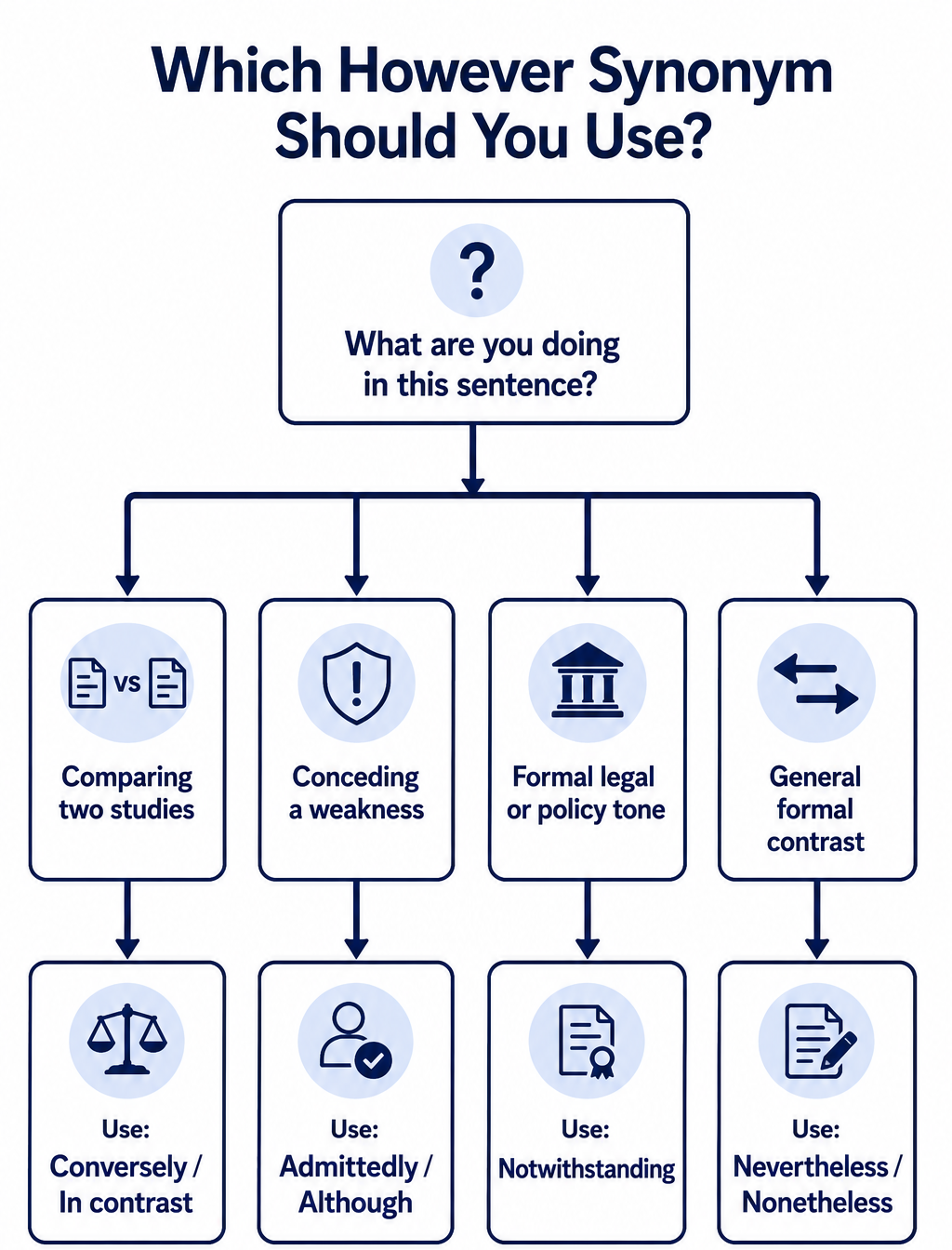
| If you need to… | Use |
|---|---|
| Join two full sentences formally | Semicolon + nevertheless / nonetheless / however |
| Compare two opposing studies | Conversely / in contrast / by contrast |
| Concede a weakness before defending your work | Admittedly / granted / although |
| Write in a legal, policy, or historical register | Notwithstanding |
| Keep a sentence short and punchy | Yet / still |
| Soften a critique of a source | That said / even so |
Frequently Asked Questions
What is the best academic synonym for “however”?
“Nevertheless” and “nonetheless” are the most widely accepted formal alternatives for academic writing, particularly in discussion and conclusion sections. Both carry the same contrastive meaning as “however” but read as slightly more emphatic and are less overused in student writing.
Is it correct to start a sentence with “however”?
Yes. Starting a sentence with “however” is grammatically correct and widely used in academic writing, provided it is followed by a comma: “However, the results did not support this hypothesis.” The idea that sentences cannot start with “however” is a style myth, not a grammar rule.
Do you need a comma after “however”?
Yes, in almost every case. When “however” starts a sentence or interrupts a clause, it takes a comma after it (and before it, if mid-clause). The only exception is when “however” is used to mean “in whatever way” or “to whatever extent” (e.g., “However you approach it, the result is the same”) — in that specific usage, no comma is required.
What’s the difference between “nevertheless” and “nonetheless”?
They are near-synonyms with the same grammatical function and punctuation rules. “Nevertheless” is slightly older and marginally more common in humanities and legal writing, while “nonetheless” is often preferred in scientific and technical writing for its brevity. Either is acceptable in most academic contexts.
Can “but” be used in academic writing instead of “however”?
“But” is grammatically acceptable but generally considered too informal to open a sentence in formal academic writing, particularly in dissertations and journal articles. It works well as a coordinating conjunction within a sentence (“the results were promising, but the sample was small”) but should not replace “however” as a sentence-opening transition in formal work.
Conclusion: Key Takeaways
“However” isn’t a mistake — but relying on it exclusively is a missed opportunity to demonstrate real control over academic register. The fix isn’t memorising a long synonym list; it’s understanding three things: the punctuation rule for the position the word sits in, the formality level each synonym carries, and which section of your paper you’re writing. Use “nevertheless” and “nonetheless” for your strongest, most formal pivots. Reach for “conversely” and “in contrast” when comparing studies. Use concessive phrases like “although” and “admittedly” when you need to acknowledge a limitation before defending your argument. And always remember the punctuation trio: semicolon before and comma after when joining two clauses, comma after when starting a sentence, and commas on both sides when interrupting a clause mid-sentence. Before you submit, run your draft through the Transition Words Checker and Passive Voice Checker to catch anything you missed. Apply these rules consistently and your transitions will read as intentional, not repetitive — exactly the impression a strong academic writer should leave.
❤️Need Affordable Assignment or Dissertation Support?
WhatsApp our writer NOW
(Click on the number to jump to the WhatsApp Message Section.): +44 7876 010823