
Reading Time: 9 minutes
If you’re staring at your Nat 5 Biology assignment thinking, “I know the biology… but how do I actually get the marks?” — you’re not alone.
Most students don’t lose marks because they’re “bad at science.” They lose marks because they don’t write in the way the SQA wants.
This guide is written like the advice you’d get from that one switched-on classmate who always seems calm before deadlines. No waffle. No jargon overload. Just clear, step-by-step help, grounded in the Scottish Qualifications Authority (SQA) standards.
By the end, you’ll know:
-
What the Nat 5 Biology assignment marking scheme actually rewards
-
How to structure analysis, evaluation, and conclusions properly
-
What first-class responses look like (with examples)
-
How to avoid the mistakes that quietly cap your marks
And yes — if you’re stuck or short on time, we’ll also show how Academic Universe can support you ethically with editing, AI checks, and assignment guidance. ✅
What Is the Nat 5 Biology Assignment (Really About)?
Let’s clear this up early — because this misunderstanding costs students marks every year.
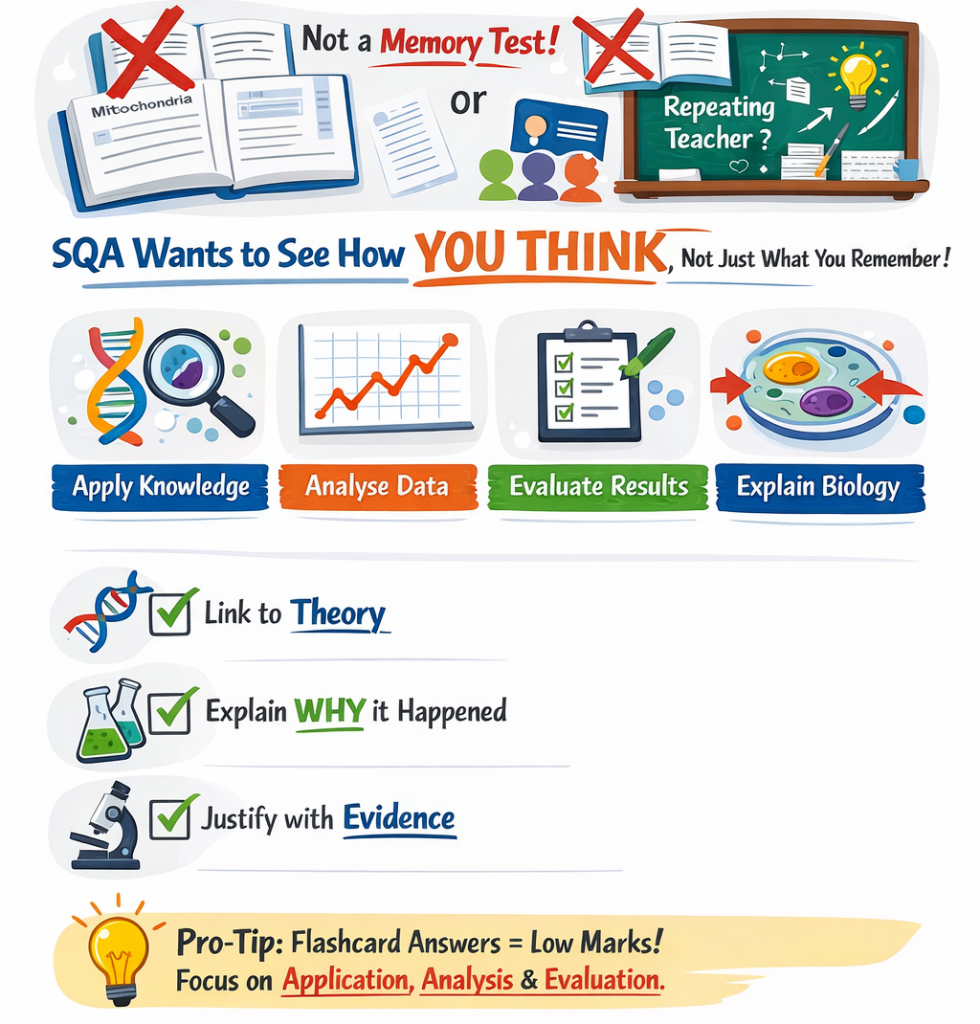
The Nat 5 Biology assignment is not a memory test. You are not being marked on how well you can recall definitions, copy notes, or repeat what your teacher said in class. Even students with strong subject knowledge can underperform if they treat the assignment like a revision exercise.
Instead, the Nat 5 Biology assignment marking scheme focuses on how well you can use your biological knowledge in context.
You’re being assessed on whether you can:
-
Apply biological knowledge to unfamiliar data, scenarios, or experiments
-
Analyse experimental data by identifying patterns, trends, and relationships
-
Evaluate methods and results, including reliability, accuracy, and limitations
-
Explain underlying biology clearly, showing cause-and-effect thinking rather than description
This is why so many Nat 5 Biology assignment examples that score highly don’t look “long” or complicated — they look precise, focused, and well-reasoned.
In simple terms:
👉 The SQA wants to see how you think, not just what you remember.
If you can:
-
Link results to biological theory
-
Explain why something happened, not just what happened
-
Justify conclusions using evidence
…then you’re working at the level required to meet — and exceed — National 5 Biology assignment understanding standards.
💡 Pro-Tip:
If a sentence in your assignment could be copied straight into a revision flashcard, it probably won’t earn high marks. Markers reward application, analysis, and evaluation, not memorisation.
Nat 5 Biology Assignment Understanding Standards (Read This First)
Before you write a single sentence of your Nat 5 Biology assignment, you must understand one thing: standards.
This is where most students lose easy marks — not because they don’t know biology, but because they don’t show it in the right way.
The Scottish Qualifications Authority (SQA) does not mark effort, neatness, or how hard you tried.
It marks evidence — clear, written proof that you meet the Nat 5 Biology assignment understanding standards.
If something is in your head but not on the page, it doesn’t count.

What “Meeting the Standard” Looks Like
To meet (and exceed) the Nat 5 Biology assignment marking scheme, your work must clearly show:
-
Accurate biological knowledge
Facts must be correct and relevant to the task — no half-remembered definitions. -
Clear links between data and conclusions
Every conclusion must be backed up by results from your experiment or data set. -
Logical explanations (cause → effect)
You explain why something happened, not just what happened. -
Correct scientific language
Use proper biological terms accurately and consistently.
📌 In short: A marker should be able to underline a sentence and say, “Yes — this proves understanding.”
What “Not Meeting the Standard” Looks Like
These are the most common reasons students fail to meet the standard in a Nat 5 Biology assignment:
-
Describing results with no explanation
Writing what the graph shows, but not explaining the biology behind it. -
Copying phrases from the candidate guide
The guide explains expectations — it is not meant to be repeated in your assignment. -
Vague statements like:
“This shows it worked” or “The experiment was successful”
(Successful why? Based on what evidence?) -
Conclusions not backed by data
Any conclusion without evidence will not be awarded marks.
🚫 Common Mistake to Avoid:
Long answers do not equal high marks. Clear, specific, evidence-based answers do.
💡 Pro-Tip:
SQA markers don’t guess what you meant and don’t read between the lines.
If your understanding isn’t clearly written, it doesn’t count — even if the biology is correct.
Nat 5 Biology Assignment Candidate Guide: How to Use It Properly
The candidate guide isn’t just paperwork — it’s a roadmap.
Use It To:
-
Check what evidence is allowed
-
Understand time and word expectations
-
See what skills are being assessed
Don’t Use It To:
-
Copy phrasing directly
-
Treat it like a template
-
Ignore the command words
Bold rule: The guide explains what, not how.
That’s your job.

Understanding the Nat 5 Biology Assignment Marking Scheme
Let’s decode the Nat 5 Biology assignment marking scheme in plain English.
Markers Are Looking For:
| Skill Area | What You Must Show | Common Mistake |
|---|---|---|
| Knowledge | Correct biology | Over-simplifying |
| Analysis | Patterns + meaning | Just describing graphs |
| Evaluation | Strengths & limits | Only saying “human error” |
| Conclusion | Data-based judgement | New info added |
📌 Key takeaway: You can lose marks even with correct biology if your analysis and evaluation are weak.
Nat 5 Biology Assignment Underlying Biology (This Is Where Top Marks Live)
This phrase scares students — but it shouldn’t.
Underlying biology simply means:
Why did this happen, biologically?
Weak Example ❌
“The rate increased because temperature increased.”
Strong Example ✅
“As temperature increased, enzyme activity rose because molecules had more kinetic energy, leading to more frequent successful collisions between enzyme and substrate.”
See the difference?
One describes. The other explains the mechanism.
💡 Pro-Tip: If your explanation includes words like because, leads to, or results in, you’re on the right track.
Nat 5 Biology Assignment Analysis (How to Do It Properly)
Analysis is where many marks are quietly lost.
What Analysis Actually Means
It’s not just:
-
“The graph goes up”
-
“There is a difference”
It is:
-
Identifying trends
-
Linking variables
-
Explaining what the data suggests
Checklist for Strong Analysis ✅
-
Refer to specific data values
-
Compare results clearly
-
Link results to biological theory
-
Avoid repeating the table/graph
📚 Nat 5 Biology Assignment Analysis Example
Instead of:
“The results show an increase.”
Write:
“Between 20°C and 40°C, the reaction rate increased steadily, suggesting enzyme activity rose with temperature up to its optimum.”
Nat 5 Biology Assignment Evaluation (This Separates A Grades from Cs)
Evaluation isn’t about complaining about the experiment.
It’s about judging quality.
Strong Evaluation Includes:
-
Reliability (repeatability)
-
Accuracy (equipment, measurements)
-
Validity (fair testing)
-
Improvements (specific, realistic)
Weak Evaluation ❌
“Human error may have affected results.”
Strong Evaluation ✅
“Inconsistent timing when measuring reaction rate may have reduced reliability; using automated timers would improve precision.”
🚫 Common Mistake to Avoid:
Never list limitations without linking them to the results.

National 5 Biology Assignment Examples: Weak vs Strong
Example Comparison
| Weak Response | First-Class Response |
|---|---|
| “Results were accurate.” | “Results were consistent across repeats, suggesting high reliability.” |
| “This shows photosynthesis occurred.” | “This indicates photosynthesis occurred as oxygen production increased with light intensity.” |
📌 Lesson: Precision beats confidence every time.
Structuring Your Nat 5 Biology Assignment (Step-by-Step)
Here’s a structure that works with the marking scheme:
1. Aim
-
Clear
-
Specific
-
Linked to variables
2. Data Presentation
-
Correct units
-
Clear tables/graphs
-
No unnecessary decoration
3. Analysis
-
Trends
-
Comparisons
-
Biological reasoning
4. Evaluation
-
Reliability
-
Limitations
-
Improvements
5. Nat 5 Biology Assignment Conclusion
-
Answer the aim
-
Use evidence
-
No new information
Writing the Nat 5 Biology Assignment Conclusion (Don’t Rush This)
The Nat 5 Biology assignment conclusion often feels like the easiest part of the task — and that’s exactly why so many students lose marks here. By the time you reach the conclusion, you’re tired, short on time, and tempted to wrap things up quickly. Unfortunately, this is one of the most assessed sections in the Nat 5 Biology assignment marking scheme.
The conclusion is where the Scottish Qualifications Authority (SQA) checks whether you truly understood your investigation. It’s not a summary of what you did. It’s a final judgement, backed by evidence and biological reasoning.
Think of the conclusion as your final answer to the question:
👉 What do the results actually show, and why does that matter biologically?
What a Strong Nat 5 Biology Assignment Conclusion Must Do
To meet the Nat 5 Biology assignment understanding standards, a strong conclusion must clearly show three things:
-
Directly answer the aim
Go back to the aim you stated at the start. Your conclusion should clearly respond to it, not just vaguely comment on success. -
Refer to results or data
You must use evidence. This could be trends, comparisons, or specific values from your results. -
Link to underlying biology
Explain why the results occurred using correct biological concepts (for example, enzymes, diffusion, photosynthesis, or respiration).
📌 Key rule: If your conclusion could be written without doing the experiment, it’s not strong enough.
Weak vs Strong Conclusions (Real Examples)
Weak Conclusion ❌
“In conclusion, the experiment was successful.”
Why this loses marks:
-
Does not answer the aim
-
No reference to results
-
No biology explained
Strong Conclusion ✅
“In conclusion, increasing temperature increased enzyme activity up to an optimum, as shown by the highest reaction rate at 40°C.”
Why this gains marks:
-
Answers the aim clearly
-
Refers to results
-
Links to enzyme activity (underlying biology)
Common Mistakes to Avoid 🚫
Students often lose marks in the Nat 5 Biology assignment conclusion by:
-
Introducing new information not mentioned earlier
-
Repeating the analysis word-for-word
-
Making claims that are not supported by data
-
Writing conclusions that are too vague or general
💡 Pro-Tip:
Use phrases like “This shows that…”, “The results suggest…”, or “This can be explained by…” to clearly link evidence to biology.
Final Advice
A strong conclusion doesn’t need to be long — it needs to be clear, specific, and evidence-based. Take a few extra minutes to write it properly. Those minutes can be the difference between meeting the standard and achieving a high-grade Nat 5 Biology assignment.
Referencing and Academic Style (Yes, It Still Matters)
While Nat 5 isn’t heavy on referencing, academic habits matter.
-
Use clear scientific language
-
Avoid slang
-
Stay objective
If referencing is required:
-
Follow Harvard style
-
Be consistent
💡 If referencing stresses you out, Academic Universe’s editing service can tidy this up without changing your voice.
Comparison Table: Average vs First-Class Assignment
| Area | Average Submission | First-Class Submission |
|---|---|---|
| Biology | Correct facts | Explained mechanisms |
| Analysis | Descriptive | Interpretive |
| Evaluation | Generic | Specific & linked |
| Conclusion | Brief | Evidence-based |
How Academic Universe Can Help (Ethically)
Let’s be clear — we don’t do your assignment for you.
What we do help with:
-
✏️ Assignment structure & clarity
-
🔍 AI detection and plagiarism checks
-
🧠 Improving analysis and evaluation
-
🧹 Proofreading and academic editing
If you’re unsure whether your work meets SQA standards, a second pair of trained eyes can make all the difference.
Final Checklist Before Submission ✅
-
Have I explained the underlying biology?
-
Does my analysis go beyond description?
-
Are my evaluations specific and realistic?
-
Does my conclusion answer the aim?
-
Have I followed the marking scheme?
If you tick all of these, you’re in strong shape.

Final Thoughts (You’ve Got This)
A first-class Nat 5 Biology assignment isn’t about sounding clever, using long words, or cramming in everything you remember from the course. It’s about thinking clearly, writing precisely, and showing evidence of understanding in a way that matches what the Scottish Qualifications Authority (SQA) is actually looking for.
Once students realise this, something important happens: the assignment stops feeling confusing or intimidating. It becomes manageable. You’re no longer guessing what the marker wants — you’re responding directly to the Nat 5 Biology assignment marking scheme, step by step.
If you:
-
Focus on underlying biology rather than surface description
-
Back up every conclusion with data or results
-
Use clear cause-and-effect explanations
-
Evaluate experiments realistically instead of vaguely
…then you’re already working at the level needed for a high-grade National 5 Biology assignment.
Remember, many students lose marks not because their biology is wrong, but because their answers are too vague, not linked to evidence, or unclear. Precision beats confidence every time. A short, well-explained answer that directly addresses the task will always score higher than a long, unfocused one.
The good news? These skills improve quickly once you know what to look for. With practice, analysing data, evaluating methods, and writing strong conclusions start to feel natural — not forced.
And you don’t have to do it alone.
At Academic Universe, we support students ethically and professionally. That means:
-
Helping you understand feedback and marking criteria
-
Improving clarity, structure, and academic tone
-
Running AI detection and plagiarism checks for peace of mind
-
Providing editing and proofreading that keeps your own voice intact
We don’t replace your learning — we strengthen it.
💡 Final Reminder:
Confidence in your Nat 5 Biology assignment doesn’t come from luck. It comes from knowing the standards, following the structure, and explaining your biology clearly.
👉 Ready to level up your Nat 5 Biology assignment?
Explore our assignment guidance, editing, and AI-check services today — and submit your work knowing it truly meets the standard. ✅


