Reading Time: 9 minutes
PART 1: Gibbs’ Reflective Cycle in Academic Practice
Reflection is a key part of academic learning in the UK, especially in subjects such as nursing, health and social care, education, and professional practice. Many students are asked to write reflective assignments but struggle to understand how reflection should be structured academically. One of the most widely used models for reflective writing is the Gibbs Reflective Cycle.
This guide explains what the Gibbs Reflective Cycle is, why it is used, and how to apply it step by step, with clear academic examples. It is written in simple language for UK university and SQA students, and follows accepted academic standards.
What Is Gibbs Reflective Cycle?
The Gibbs Reflective Cycle is a structured framework for reflection developed by Graham Gibbs in 1988. It helps learners reflect on experiences in a logical, organised, and critical way, rather than simply describing what happened.
The model encourages students to:
-
Think about an experience
-
Analyse their actions and feelings
-
Learn from the experience
-
Plan how to improve in the future
This makes it especially useful for academic reflective writing, where critical thinking and learning outcomes are assessed.
What Is Gibbs Reflective Cycle Used For?
Students often ask: what is Gibbs reflective cycle used for?
The model is used to:
-
Support reflective writing in assignments
-
Help students link theory to practice
-
Encourage critical thinking
-
Improve professional development
-
Demonstrate learning and self-awareness
In the UK, the Gibbs reflective cycle is commonly used in:
-
Nursing and healthcare education
-
Health & social care courses
-
Teaching and education degrees
-
Work-based learning and placements
-
Professional development portfolios
Gibbs Reflective Cycle Model Explained
The Gibbs reflective cycle model consists of six stages. These stages guide the student from describing an experience to planning future improvement.
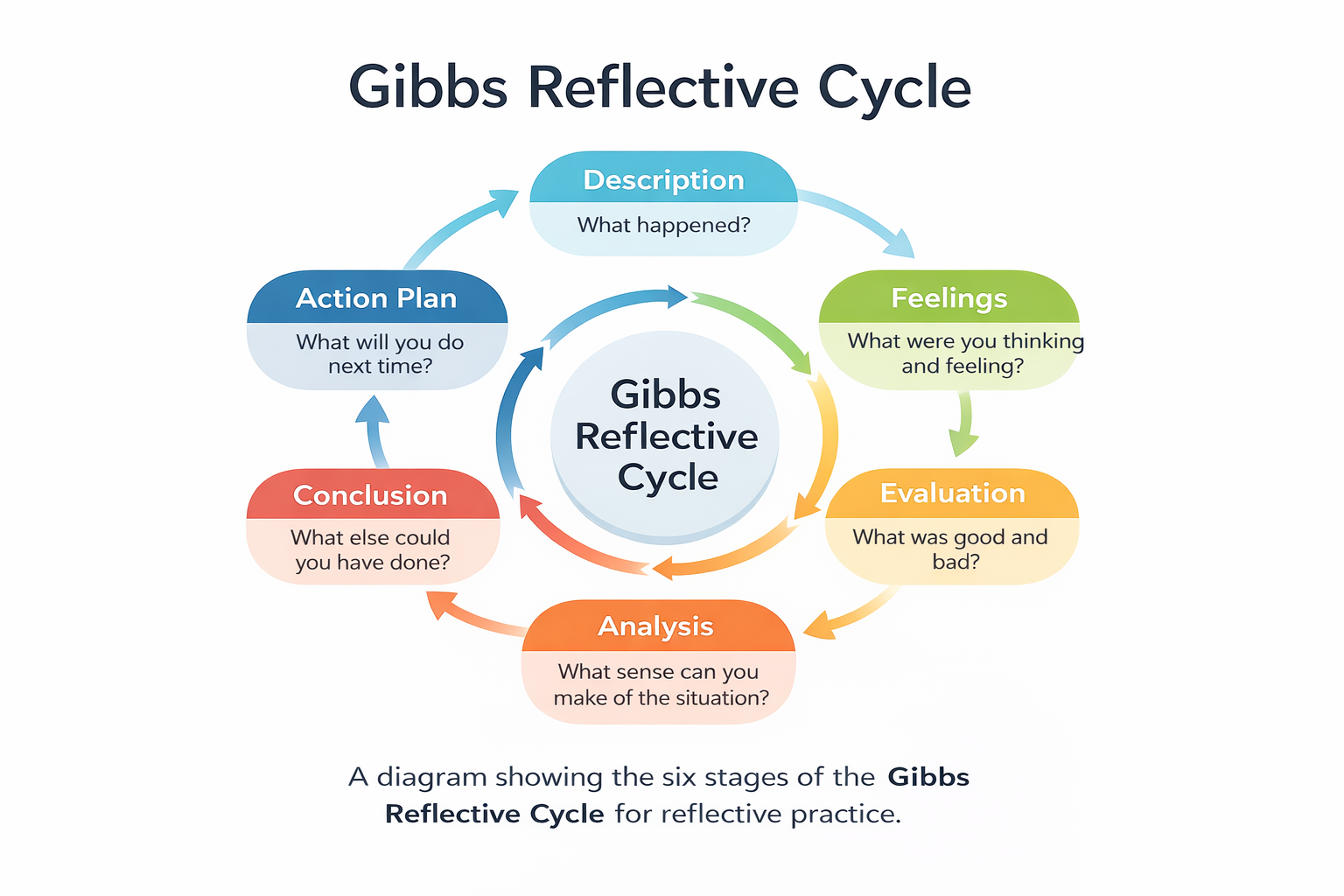
The six stages are:
-
Description
-
Feelings
-
Evaluation
-
Analysis
-
Conclusion
-
Action Plan
Each stage has a specific purpose and should be addressed separately and clearly in academic writing.
Gibbs Reflective Cycle Diagram (Explained in Words)
Although the Gibbs reflective cycle diagram is usually shown as a circle, it can be explained simply:
-
Reflection starts with an experience
-
Moves through thoughts, evaluation, and analysis
-
Ends with planning future action
-
Then repeats when a new experience occurs
This circular structure shows that reflection is a continuous learning process, not a one-time task.

Stage 1: Description – What Happened?
The description stage answers the question:
What happened?
At this stage, students should:
-
Briefly describe the situation or experience
-
Stick to facts
-
Avoid analysis or opinions
Academic Example (Health & Social Care)
During my placement in a care home, I supported an elderly resident who became distressed during personal care. The resident refused assistance and appeared anxious, requiring support from a senior staff member.
This stage sets the context but does not explain why things happened yet.
Stage 2: Feelings – What Were You Thinking and Feeling?
The feelings stage explores emotional responses, which is why Gibbs is popular in caring professions.
Students should:
-
Describe their thoughts and feelings honestly
-
Keep an academic tone
-
Avoid emotional exaggeration
Gibbs Reflective Cycle Example (Nursing UK)
At the time, I felt unsure about how to respond appropriately. I was concerned about maintaining the resident’s dignity while also ensuring their safety. I also felt slightly anxious due to my lack of experience.
This shows self-awareness, which UK markers value.
Stage 3: Evaluation – What Was Good and Bad About the Experience?
The evaluation stage focuses on:
-
What went well
-
What did not go well
This stage should be balanced, not overly negative or positive.
Academic Example
One positive aspect was that I recognised the resident’s distress early and sought support. However, a negative aspect was that I lacked confidence in communicating effectively to reassure the resident independently.
Evaluation helps show critical thinking, not blame.
Stage 4: Analysis – What Sense Can You Make of the Situation?
This is the most important stage and where many students lose marks.
The analysis stage answers:
-
Why did things happen this way?
-
How does theory explain this experience?
Here, students should:
-
Link experience to academic theory
-
Use references where appropriate
-
Show deeper understanding
Gibbs Reflective Cycle Analysis Example
Effective communication is essential in health and social care settings, particularly when supporting individuals experiencing distress. According to person-centred care principles, understanding individual needs and preferences can reduce anxiety. My limited experience may have affected my ability to apply these principles confidently.
This is where learning happens, not just reflection.
Stage 5: Conclusion – What Else Could You Have Done?
The conclusion stage summarises learning.
Students should:
-
Identify what they learned
-
Explain what they could do differently
Example
This experience highlighted the importance of developing effective communication skills when supporting distressed individuals. I learned that remaining calm and using reassurance techniques can improve outcomes.
This stage shows growth and understanding.
Stage 6: Action Plan – What Will You Do Next Time?
The action plan stage focuses on future improvement.
Students should explain:
-
How they will improve
-
What skills they will develop
-
How learning will be applied
Example
In future practice, I will observe experienced staff to improve my communication techniques and seek feedback to enhance my confidence when supporting residents independently.
UK universities place strong emphasis on this stage because it shows applied learning.

Common Mistake Students Make in Analysis
Many students:
-
Repeat the description
-
Forget to link theory
-
Do not explain why something happened
This weakens the assignment and reduces marks.
Gibbs Reflective Writing: Academic Style Tips
Good Gibbs reflective writing should:
-
Use first person (“I”) where appropriate
-
Maintain an academic tone
-
Avoid informal language
-
Follow the six stages clearly
Headings or clear paragraphs for each stage are strongly recommended.
Gibbs Reflective Cycle Reference (Harvard)
When referencing the original model, the correct Harvard reference is:
Gibbs, G. (1988). Learning by Doing: A Guide to Teaching and Learning Methods. Oxford: Further Education Unit, Oxford Polytechnic.
This reference should be included in the reference list of reflective assignments.
Gibbs Reflective Cycle in Learning
The Gibbs reflective cycle in learning helps students:
-
Understand experiences deeply
-
Improve professional practice
-
Develop lifelong learning skills
It moves learning beyond memorisation to self-improvement and critical reflection.
Why Universities Prefer the Gibbs Cycle
Universities prefer the Gibbs model because it:
-
Is structured and easy to assess
-
Encourages critical thinking
-
Aligns with learning outcomes
-
Supports professional development
This makes it ideal for reflective assignments in the UK.
PART 2: Applying Gibbs’ Reflective Cycle in Academic Practice
In Part 1, we explored what the Gibbs Reflective Cycle is, its six stages, and how each stage should be written academically. In this second part, we focus on practical application, especially for UK students, with extended examples, comparisons, strengths and weaknesses, and guidance on how to use the model effectively in assignments.
Gibbs Reflective Cycle Nursing UK: Full Academic Example
One of the most common searches is “Gibbs reflective cycle nursing UK”, as nursing and healthcare students are frequently required to submit reflective assignments.
Below is a complete nursing-based example, written in an academic style suitable for UK universities.
Example Context (Nursing Placement)
A student nurse reflects on an interaction with a patient who was anxious before a clinical procedure.
1. Description – What Happened?
During my clinical placement on a medical ward, I assisted in preparing a patient for a routine blood test. The patient appeared visibly anxious and repeatedly asked questions about the procedure. I attempted to reassure the patient while preparing the equipment.
This stage remains factual and brief, with no judgement.
2. Feelings – What Were You Thinking and Feeling?
At the time, I felt slightly nervous as I was still developing my communication skills. I also felt concerned that my reassurance was not effective, which increased my awareness of the patient’s anxiety.
This shows self-awareness, not emotion dumping.
3. Evaluation – What Was Good and What Was Not?
A positive aspect was that I recognised the patient’s anxiety and attempted to respond calmly. However, a negative aspect was that I relied on generic reassurance rather than adapting my communication to the patient’s individual concerns.
Balanced evaluation is critical for marks.
4. Analysis – Why Did This Happen?
Effective communication is a fundamental aspect of nursing practice, particularly when managing patient anxiety. Research highlights that patient-centred communication improves trust and reduces distress. My limited experience may have affected my ability to tailor reassurance strategies, demonstrating the importance of developing confidence through practice and supervision.
This stage links theory to practice, which is where high grades come from.
5. Conclusion – What Have You Learned?
This experience highlighted the importance of adapting communication strategies to individual patient needs. I learned that acknowledging specific concerns rather than offering general reassurance can improve patient comfort.
6. Action Plan – What Will You Do Next Time?
In future placements, I will observe experienced nurses using reassurance techniques and seek feedback on my communication skills to improve patient interactions.
This completes the reflective cycle and demonstrates learning and improvement.
Why Gibbs Reflective Cycle Works Well for Nursing and Healthcare
The Gibbs model is widely used in healthcare because it:
-
Encourages reflection on feelings and emotions
-
Promotes patient-centred care
-
Supports professional development
-
Helps meet UK regulatory expectations
Gibbs Reflective Cycle in Learning and Education
The Gibbs reflective cycle in learning is not limited to healthcare. It is also widely used in:
-
Teacher training
-
Social work
-
Education studies
-
Work-based learning
Example (Education Student)
A trainee teacher reflecting on a lesson that did not go as planned:
-
Description: The lesson ran over time and students lost focus
-
Feelings: Frustration and concern
-
Evaluation: Lesson objectives were clear, but pacing was poor
-
Analysis: Poor time management reduced engagement
-
Conclusion: Lesson planning needs flexibility
-
Action Plan: Introduce time checkpoints in lesson plans
This shows how Gibbs supports professional learning, not just emotional reflection.
Helpful reads:
-
How to Use AI in SQA Assessments: A Complete Step-by-Step Guide
-
Standard UK Assignment Structure: The “Introduction to Conclusion” Template
-
10 Common Academic Writing Mistakes UK Students Make (And How to Fix Them)
- Why Ignoring PESTLE Analysis is a Risky Academic Mistake: Don’t Fail Your 2026 Finals
Gibbs Reflective Cycle Stages Explained (Quick Table)
| Stage | Key Question | What to Include | Common Mistake |
|---|---|---|---|
| 🟢 Description | What happened? | Facts only | Too much detail |
| 🟡 Feelings | What did you feel? | Honest reflection | Over-emotional tone |
| 🟢 Evaluation | What was good/bad? | Balanced judgement | One-sided view |
| 🔵 Analysis | Why did it happen? | Theory + explanation | Repeating description |
| 🟢 Conclusion | What did you learn? | Key learning points | New information |
| 🔴 Action Plan | What next? | Clear improvement steps | Vague future plans |
✅ Clear structure = higher marks
❌ Missing stages = lost marks
Gibbs Reflective Cycle Diagram (Text Explanation)
Although often shown as a circular diagram, the key idea is:
-
Reflection is continuous
-
Each experience informs the next
-
Learning improves over time
Students should remember that the action plan feeds into future experiences, completing the learning cycle.
Gibbs Reflective Cycle Model vs Other Reflection Models
Students often ask whether Gibbs is the best model. Below is a simple comparison.
Comparison Table
| Model | Structure | Best For | Difficulty |
|---|---|---|---|
| ✅ Gibbs Reflective Cycle | 6 clear stages | Assignments & placements | Easy |
| Kolb’s Learning Cycle | Theory-based | Learning styles | Medium |
| Rolfe’s Model | 3 questions | Short reflections | Easy |
| Schön’s Model | Reflection-in-action | Professional practice | Advanced |
👉 Gibbs is preferred in UK assignments because it is structured and assessor-friendly.
Advantages and Disadvantages of Gibbs Reflective Cycle
Advantages ✅
-
Clear step-by-step structure
-
Easy for beginners
-
Encourages deep learning
-
Widely accepted in UK education
-
Supports academic marking criteria
Disadvantages ❌
-
Can feel repetitive
-
Less flexible for advanced learners
-
Focuses heavily on emotions
-
May limit creativity
When Should You Use Gibbs Reflective Cycle?
Use Gibbs when:
✔ The assignment asks for reflection
✔ You need a structured approach
✔ You are new to reflective writing
✔ The course is UK-based
Avoid using it when:
❌ The task is purely analytical
❌ Reflection is not required
Common Mistakes Students Make (And How to Avoid Them)
❌ Mistake 1: Writing a Story
Reflection is not storytelling. Keep it structured.
❌ Mistake 2: Skipping Analysis
Analysis is the highest-mark stage. Always link theory.
❌ Mistake 3: Weak Action Plans
“Next time I will do better” is not enough.
❌ Mistake 4: No Academic Reference
Always reference the original model when required.

Gibbs Reflective Cycle Reference (Harvard Style)
Correct Harvard reference:
Gibbs, G. (1988). Learning by Doing: A Guide to Teaching and Learning Methods. Oxford: Further Education Unit, Oxford Polytechnic.
Include this in your reference list when using the model.
How to Structure a Gibbs Reflective Cycle Assignment
Recommended Structure
-
Introduction (brief context)
-
Gibbs Stage 1–6 (with headings)
-
Conclusion (optional summary)
-
Reference list
💡 Use headings for each stage to make it clear for markers.
Does Gibbs Reflective Cycle Improve Grades?
Yes — when used correctly.
Markers reward:
-
Clear structure
-
Critical thinking
-
Learning from experience
-
Evidence of improvement
Gibbs helps students demonstrate all four.
Final Thoughts: Why Gibbs Reflective Cycle Still Matters
The Gibbs Reflective Cycle remains one of the most effective reflective models because it transforms experiences into structured learning. For UK students, especially in health, education, and professional courses, it provides a clear, assessable framework that meets academic expectations.
When used correctly, it does not just help students pass assignments, but helps them learn, grow, and improve professionally.
Frequently Asked Questions (FAQs)
What is Gibbs reflective cycle used for?
It is used to structure reflection in academic and professional learning.
Is Gibbs reflective cycle accepted in UK universities?
Yes, it is widely accepted and recommended.
Can I use first person in Gibbs reflective writing?
Yes. First person (“I”) is appropriate.
Is Gibbs reflective cycle suitable for nursing?
Yes, it is one of the most commonly used models in nursing education.
How long should a Gibbs reflection be?
This depends on assignment requirements, but clarity matters more than length.